No products in the basket.

Electric Underfloor Heating Cost: What You’ll Pay to Buy, Fit and Run It
The electric underfloor heating cost for a typical 4m² bathroom starts from around £117 for the heating mat, thermostat and insulation boards, plus £250 to £600 for an electrician to connect it. Tile adhesive and levelling compound are extra. Our 150W/m² heating mats start from £18.99 and our 200W/m² mats from £22.99, correct at the time of writing. To run, a 150W/m² mat costs just under 4p per square metre per hour at full output, based on the current price cap rate of 26.32p per kWh. Once the floor is up to temperature the thermostat switches the mat on and off, so it won’t be drawing full power all the time.
We get asked about cost a lot, and the honest answer comes in three parts. There’s what you pay for the kit, what the electrician charges to connect it, and what it adds to your electricity bill. Below we go through each one with real prices from our shop, then put the electric underfloor heating cost for a typical bathroom together in one table so you can see the full picture.
How much does electric underfloor heating cost to buy?
The heating mat is the biggest part of the bill. Mats are sold by area, so the price goes up with the size of the floor you want to heat. There are two outputs to choose from.
| Mat size | 150W/m² mat | 200W/m² mat |
|---|---|---|
| 0.5m² | £18.99 | £22.99 |
| 1m² | £27.99 | £30.99 |
| 2m² | £44.99 | £50.99 |
| 4m² | £77.99 | £88.99 |
| 6m² | £108.99 | £132.99 |
| 10m² | £170.99 | £205.99 |

Prices are for the mat on its own, include VAT and are correct at the time of writing. Check the product page for the current price. Our mesh mats and loose wire systems come with a lifetime warranty when they’re installed correctly, and our foil mats come with a 15-year warranty.
The 150W/m² mat is fine for most rooms, as long as it’s laid on insulation boards. If the floor is going to be the main heat in the room, or the room loses heat quickly like a conservatory, we recommend the 200W/m² mat. The difference in price is small, £77.99 against £88.99 for a 4m² mat, so unless your electrics limit the load there’s little reason not to go for 200W/m². If you’re not sure which one your room needs, give us a call and we’ll tell you.
You don’t need to heat the whole room. A mat never goes under the bath, the toilet, a fitted vanity unit or anything else that stands flush on the floor. Measure the floor that’s left and aim to cover around 80 to 85% of it, so a bathroom with 5m² of open floor would take a 4m² mat.
On top of the mat you need a thermostat. Every system needs one, it’s what controls the floor temperature and stops the mat running when it doesn’t need to. You can add one when you choose your mat. The M1 dial thermostat is the simplest and cheapest at £14.99. If you want to set the heating to come on at certain times, which helps keep the running cost down, the M5 digital is £25.99 and the T5 touch screen is £42.99. The Wi5 WiFi thermostat at £67.99 lets you control it from an app on your phone.
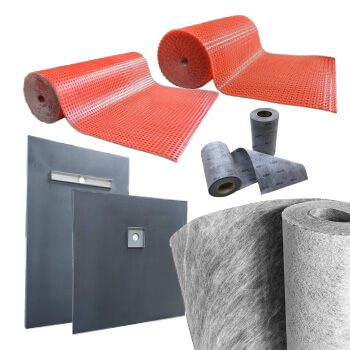
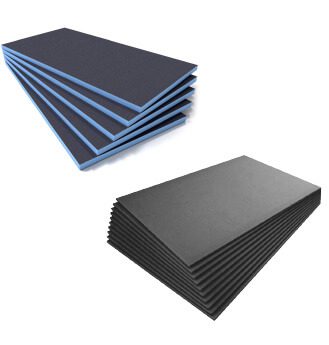
The last part is insulation. Laying the mat on insulation boards sends the heat up into the room instead of down into the subfloor, which means the floor warms up faster and the mat runs for less time. Our XPS insulation boards are the budget option, from £2.19 for a 6mm board measuring 600 x 620mm. They work under most floor finishes. Our tile backer boards are the trade standard and the proper job if you’re tiling. They’re 1200 x 600mm with a pre-keyed face the tile adhesive grips to, and they’re the ones we recommend on a timber subfloor. They cost more, from £44.95 for a pack of five that covers 3.6m². Tile backer boards can’t be used with foil mats.
Electric underfloor heating cost for a 4m² bathroom
Here’s what a typical bathroom with 4m² of open floor would cost with our standard kit. We’ve priced it on our lowest-cost options, the 150W/m² mat, the M1 thermostat and 6mm XPS boards, to show you the starting point.
| Item | What you need | Price |
|---|---|---|
| 150W/m² heating mat | 4m² mat | £77.99 |
| M1 dial thermostat | 1 | £14.99 |
| 6mm XPS insulation boards | 11 boards to cover 4m² | £24.09 |
| Kit total | £117.07 | |
| Electrician to connect | Final connection and thermostat | £250 to £600 |
Prices include VAT and are correct at the time of writing. On a timber floor, swap the XPS for two packs of tile backer boards (£89.90), which brings the kit to £182.88. You’ll also need a flexible tile adhesive, and a levelling compound if the floor isn’t flat, which most people are buying for the tiling anyway.
For everything else that goes into the room, see our bathroom underfloor heating page.
How much does it cost to install?
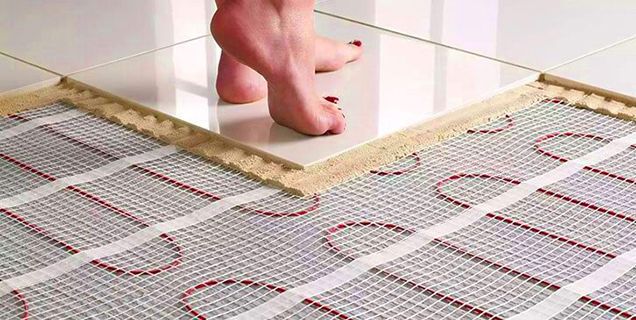
If you’re handy with DIY, laying the mat and the boards on a basic installation is a job you can do yourself. The mat rolls out, you cut the mesh to turn it at the walls without cutting the cable, and it goes down before the tile adhesive. Our guide to installing underfloor heating under tiles walks you through it step by step.
The part you can’t do yourself is the electrics. You’ll need a qualified electrician to make the final connection and wire in the thermostat. Get a quote from your local electrician, but published UK price guides put it at somewhere between £250 and £600, depending on who you use, where you live and whether they need to run a new circuit. That should include the Part P certificate, so check it’s in the quote. The guides put London and the South East at the top end of that range.
On bigger projects, or if you’d rather not lay it yourself, a floor fitter or tiler can do it as part of the job. Ask them to price it in with the tiling, as it doesn’t add much time when the floor is already up.
This is general guidance. Rules on electrical work in bathrooms vary across the UK, so always check with a registered electrician before you start.
How much does electric underfloor heating cost to run?
Working out the running cost is easier than people expect. Take the mat output in watts, multiply it by the area, and divide by 1,000 to get kilowatts. Multiply that by your electricity unit rate and you have the cost per hour at full output.
For a 4m² mat at 150W/m², that’s 150 x 4 = 600W, or 0.6kW. At the current price cap rate of 26.32p per kWh, it costs about 15.8p an hour when it’s running flat out.
| Heated area | 150W/m² per hour | 200W/m² per hour |
|---|---|---|
| 1m² | 3.9p | 5.3p |
| 4m² | 15.8p | 21.1p |
| 10m² | 39.5p | 52.6p |
Based on the Ofgem price cap average of 26.32p per kWh for 1 October to 31 December 2026. Your own rate depends on your supplier, tariff and region, so check your bill.
These are the costs at full output, which is the worst case. The mat works hardest while it brings a cold floor up to temperature. After that the thermostat switches it on and off to hold the temperature you’ve set, so the real cost per hour is lower. How much lower depends on the room, the insulation underneath and how warm you like it.
To give you a feel for it, if a 4m² mat ran at full output for a total of three hours in a day, that’s about 47p. A good way to keep it down is to set the thermostat to come on before you get up and switch off when you leave, rather than leaving it on all day. On cheaper overnight tariffs the running cost drops again.
Is electric underfloor heating cheaper to run than a wet system?
Usually not, and we’d rather tell you that straight. Wet (water) systems run off a boiler or a heat pump, and the heat from those generally costs less per unit than heat from electricity. If you’re heating a whole house, a new build or a big extension, a water system will normally be cheaper to run.
Where electric systems win is on the cost and hassle of fitting. Water systems are more expensive to install because they need pipework, a manifold and a connection to your heating, and they usually sit in a screed, which raises the floor. An electric mat is only a few millimetres thick, goes straight under the tiles and is connected by an electrician in a few hours. For a single bathroom, kitchen or conservatory, that difference in install cost can take years to make back in running costs. Wet systems also need servicing over the years, while electric underfloor heating is maintenance free.
Electric underfloor heating is also energy efficient at the point of use. Every unit of electricity it uses is turned into heat in the floor, and because the heat comes up from the whole floor area, a lot of people find they’re comfortable with the room thermostat set a little lower.
How to keep your running costs down
- Lay the mat on insulation boards. It’s the single biggest thing you can do to cut the running cost.
- Use a programmable thermostat so the heating only runs when you’re using the room.
- Only heat the open floor, not under baths, toilets or fitted units.
- Pick the right output for the room and how you’ll use it. If you’re unsure, give us a call.
Everything you need for a typical bathroom
These are the products in our worked example above, the standard kit for a bathroom floor.


If you want the electric underfloor heating cost for your own room, send us the floor measurements or give us a call on +44 (0)1803 316060. We’ll tell you which mat, thermostat and boards you need and what it all comes to.